Web development, built from scratch.
Most agencies assemble. We build. Every site we ship is written for its purpose — no page builder, no theme bought and bent into shape, no forty plugins holding the seams together. That is what makes a site fast on the first load and still maintainable three years later.
What we build
Not every business needs the same thing, and the word *website* covers projects that have almost nothing in common.
Marketing and brand sites.
A handful of pages whose entire job is to make a stranger trust you and get in touch. Speed and clarity matter more than features. This is where a heavy template hurts most: a visitor who waits four seconds has already left.
Content platforms.
Sites where someone on your team publishes, edits and reorganises without calling us. We build these on a headless CMS, so the editing experience stays clean and the front end stays fast — two separate systems that never slow each other down.
Web applications.
Dashboards, booking systems, internal tools, customer portals. Anything with accounts, permissions, data and business logic. Here most of the work is invisible: what you see is a screen, what you pay for is the model underneath that keeps the data correct.
E-commerce.
Catalogue, cart, payment, order flow. We integrate the payment provider that fits your market rather than the one that fits our habits — a Moroccan checkout and a European one do not have the same constraints, and the wrong choice is felt at every transaction.

How we work
We start with a call, not a quote.
Thirty minutes, free, no commitment. We would rather understand what you are trying to change before putting a number on it. Half the time that call shows the project is smaller than you thought. Occasionally it shows it is bigger — better to know before signing.
Then a written plan.
Scope, phases, what is in and what is deliberately out. The second list matters as much as the first: a project without an explicit *out* drifts until nobody remembers what was agreed.
Then we build in visible increments.
You see the site as it takes shape, on a real URL, not in a slideshow. Feedback that arrives while something is still being built costs nothing to apply. Feedback that arrives at the end costs a rebuild.
Then we hand over.
Code, accounts, documentation, and a walkthrough of the CMS if there is one. The site is yours. If you want us to keep maintaining it, that is a separate agreement — never a dependency we engineered on purpose.
What actually drives the timeline
Clients ask how long a site takes, and the honest answer is that page count barely matters. Three things do.
How much logic sits behind the pages.
Ten pages of content move quickly. One page with accounts, roles, payment and a state machine takes longer than the ten.
How ready the content is.
Text, images, product data. A project waiting on content is a project not being built, and this is the single most common reason a schedule slips.
How many people approve.
One decision-maker is fast. A committee is not, and that is a fact of planning rather than a complaint.
We give you a schedule after the first call, once we know which of the three applies to you. We would rather commit to a date we can hold than publish an average that means nothing.
The stack, and why it matters to you
You do not need to care about our tools. You do need to care about what they buy you.
React and Next.js.
Pages are pre-rendered, so the browser receives finished HTML instead of assembling it. That is the difference between a page that appears and a page that loads. It also means search engines and AI assistants read your content without executing JavaScript — which is exactly how they prefer to read it.
A headless CMS.
Your content lives in a real database with a real editing interface, and the site reads it when it builds. Editors get a clean back office; visitors get a static page. Neither pays for the other.
No page builders.
Every layout is written. It weighs a fraction of a generic template, it does exactly what it was designed to do, and no plugin update can break it on a Tuesday morning.
Accessibility from the start.
Keyboard navigation, contrast, screen reader labels, motion that respects the system preference. Retrofitting accessibility costs several times what building it in costs, and across Europe it is shifting from courtesy to legal requirement.
Performance is not a phase at the end
Speed is decided by architecture, not by a plugin installed the week before launch. Image formats, font loading, how much JavaScript ships to the browser, whether a page is generated ahead of time or on demand — those choices are made in the first week and they set the ceiling for everything after.
The same holds for search. A site that is fast, semantically structured and serves real HTML gives search engines and AI assistants something to work with. A site assembled from a template usually gives them a wall of markup and a two-second wait.
Proof
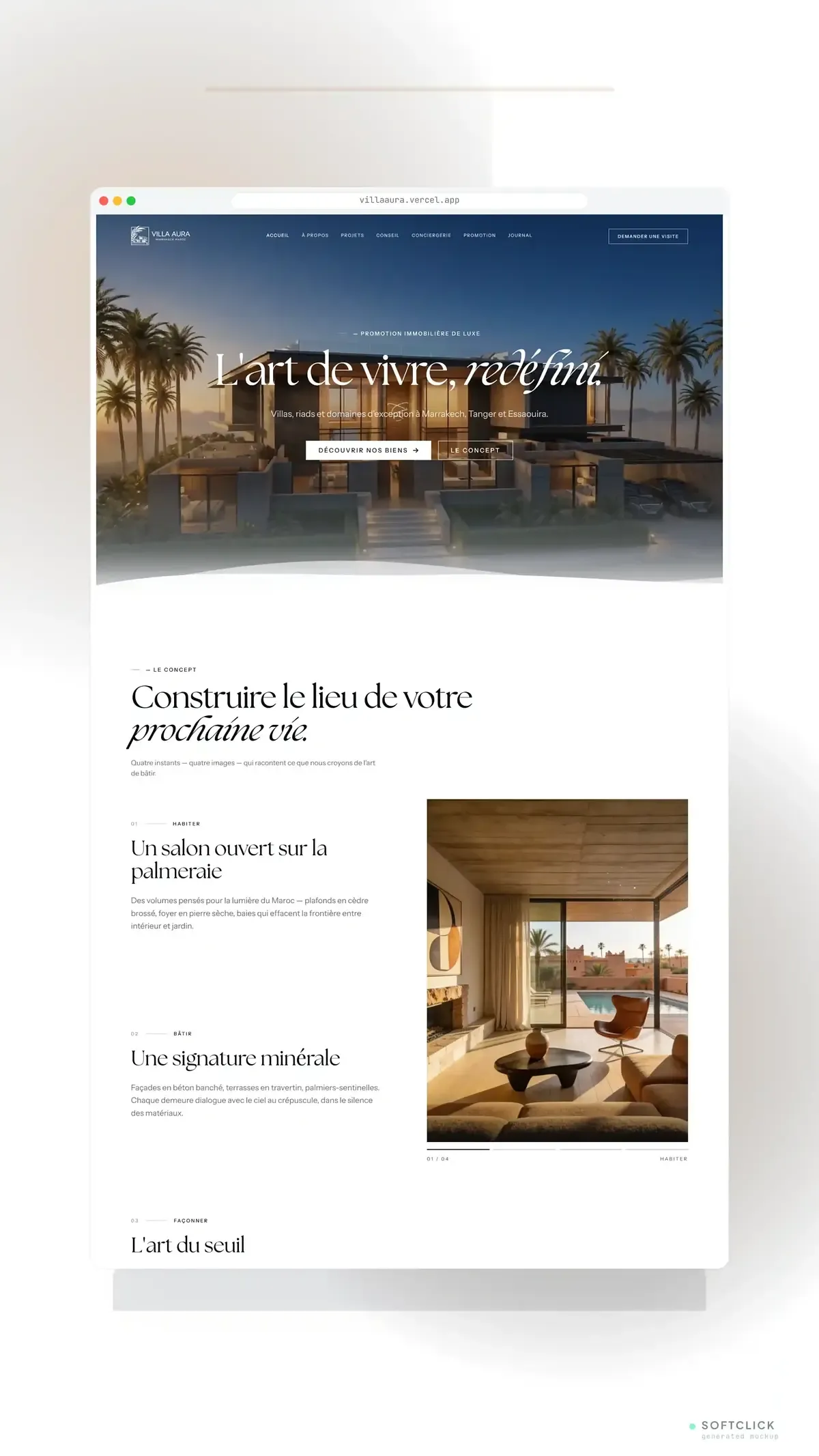
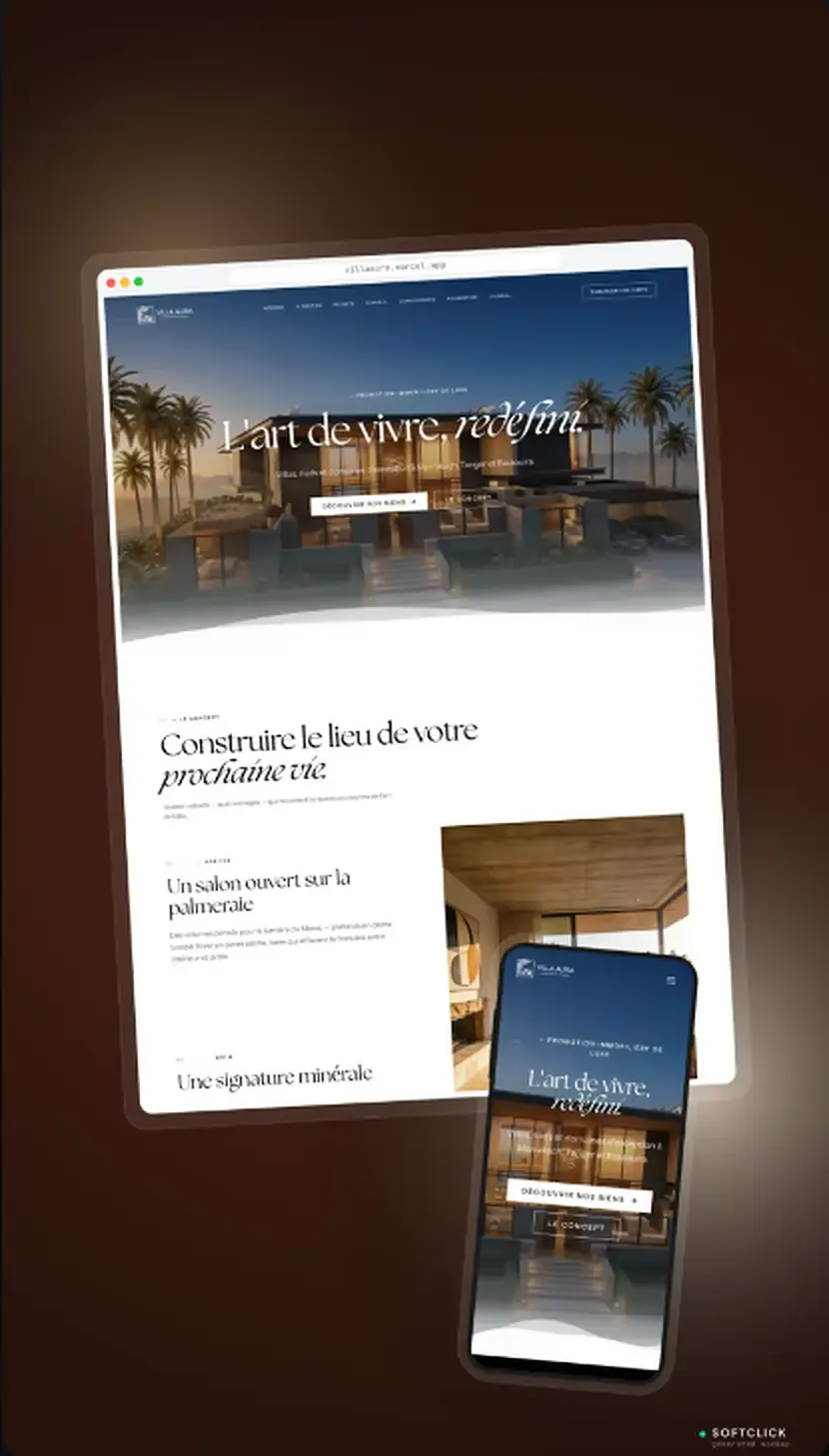
Villa Aura
— a web platform for luxury villa rental in Marrakech: cinematic galleries, an editorial journal, and a direct booking path that removes the intermediary.
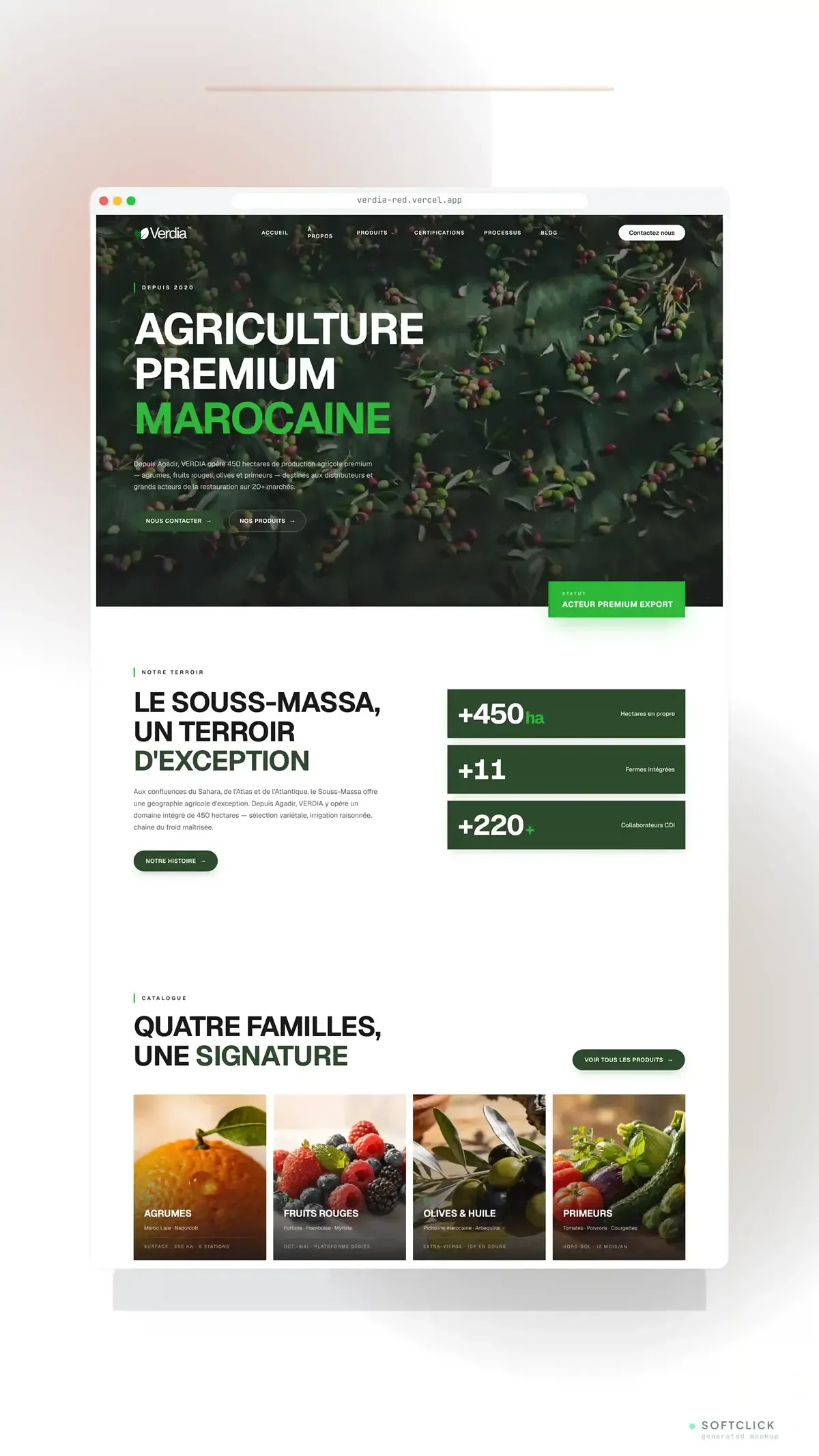
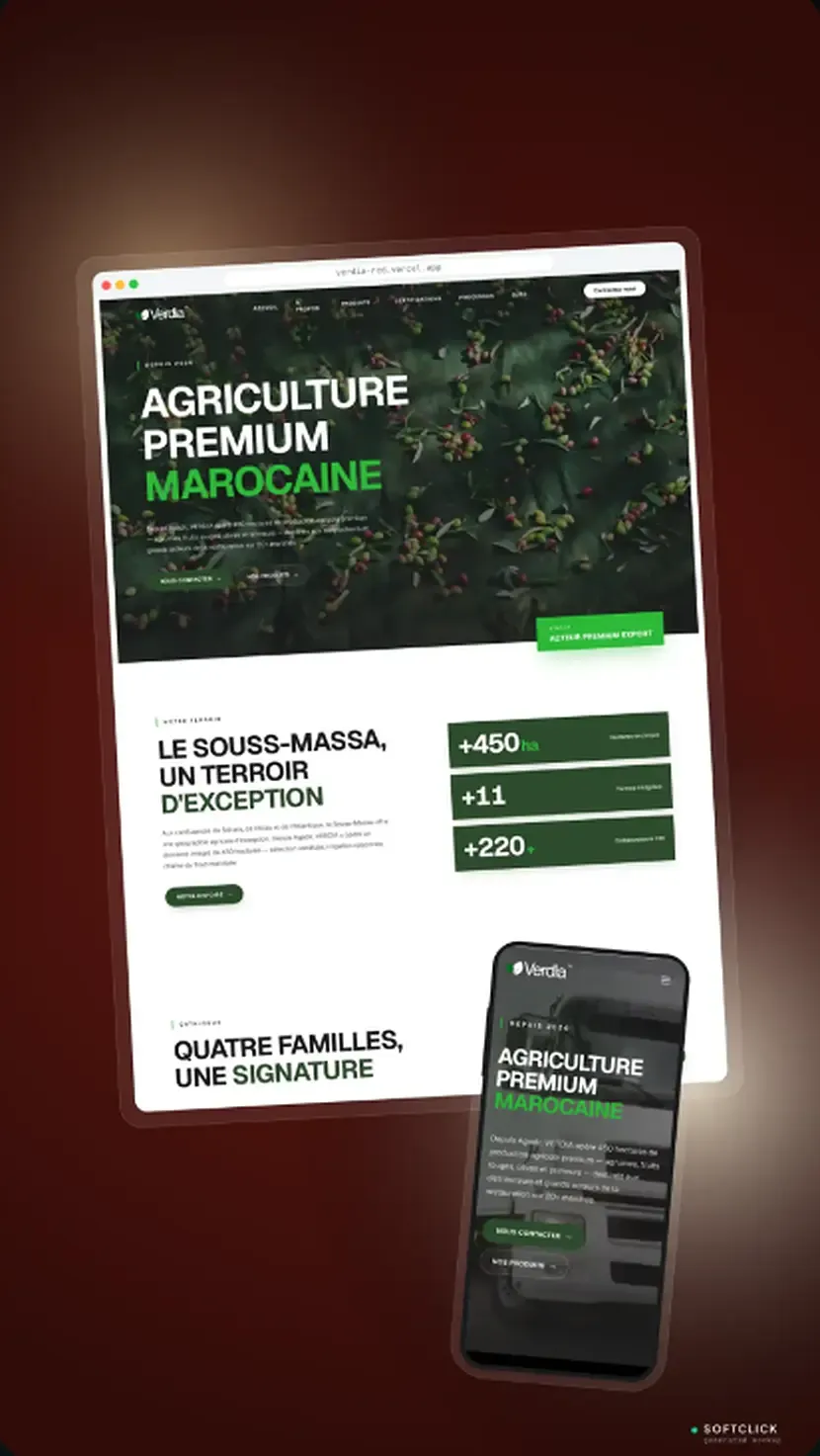
Verdia
— a corporate platform for a Moroccan agricultural exporter: an immersive product catalogue, an editorial blog, and a headless architecture built for B2B lead generation.
Dune Riders
— a booking platform for desert excursions: tour catalogue, availability, and a reservation flow designed mobile-first.
All three are live, and each is a page away.
What it costs
We work in four brackets, and we tell you which one you are in during the first call rather than after three weeks of discovery.
1,500 – 5,000 $
a focused marketing site, a handful of pages, custom design, CMS optional.
5,000 – 10,000 $
a full site with a CMS, several content types, multilingual if needed.
10,000 – 20,000 $
a web application: accounts, business logic, integration with your existing tools.
20,000 $ and above
a platform: several connected systems, complex data models, long-term collaboration.
These are ranges, not price lists. What moves a project between brackets is almost never the number of pages — it is the amount of logic behind them.

Selected work
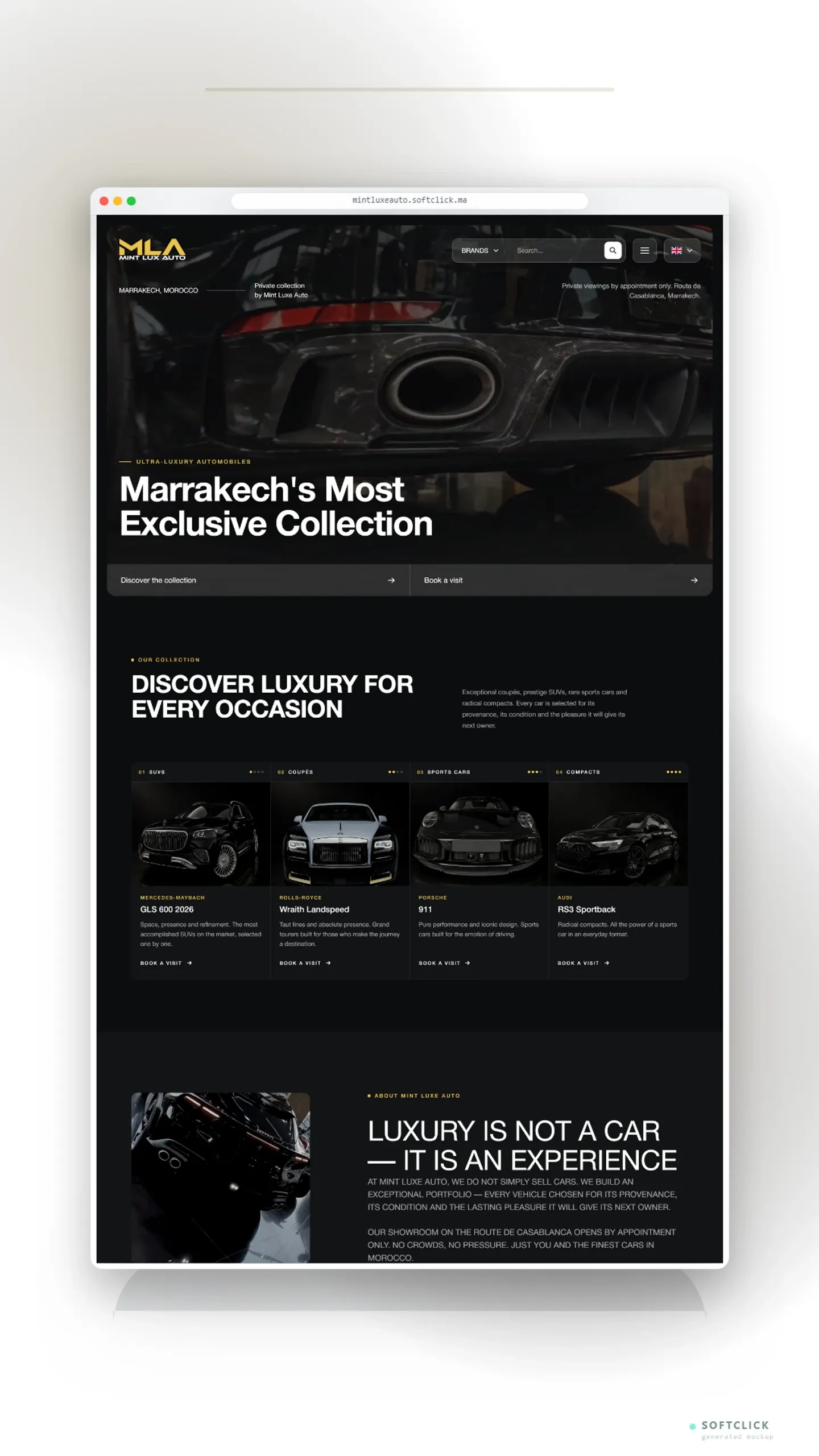
Projects delivered under this service.

Frequently asked questions
- Can I edit the content myself?
- Yes, if we build you a CMS. You get a back office where you write, upload images and publish, without touching code and without breaking the layout. If your site is five pages that never change, we will tell you a CMS is not worth its cost.
- Do you work with clients outside Morocco?
- Yes. We work remotely with clients across Europe and the MENA region. Time zones overlap comfortably with both, and everything — calls, files, deliveries — happens online.
- What happens if I want changes after launch?
- We agree on that before delivery rather than after, so nobody is surprised. Some projects end with a clean handover and nothing more; others continue as a maintenance agreement. Either way the code and the accounts are yours from day one — we do not build dependencies on purpose.
- Do you redesign existing sites?
- Yes, and it is often the better option. If your content and positioning are sound, rebuilding the front end costs far less than starting over. The first call is where we work out which of the two you actually need.
- What technologies do you use?
- React and Next.js for the front end, a headless CMS for content, PostgreSQL when there is data to model. We choose per project — but never a page builder, and never a stack only we can maintain.
- Will my site work on mobile?
- Every site we build is designed on mobile first and tested on real screen sizes, not just resized in a browser. Most of your visitors will arrive on a phone; a site that treats mobile as an afterthought loses them before it says anything.
Have a project in mind? Book a free 30-minute call. We will tell you what it takes, what it costs, and whether we are the right people for it. No commitment.